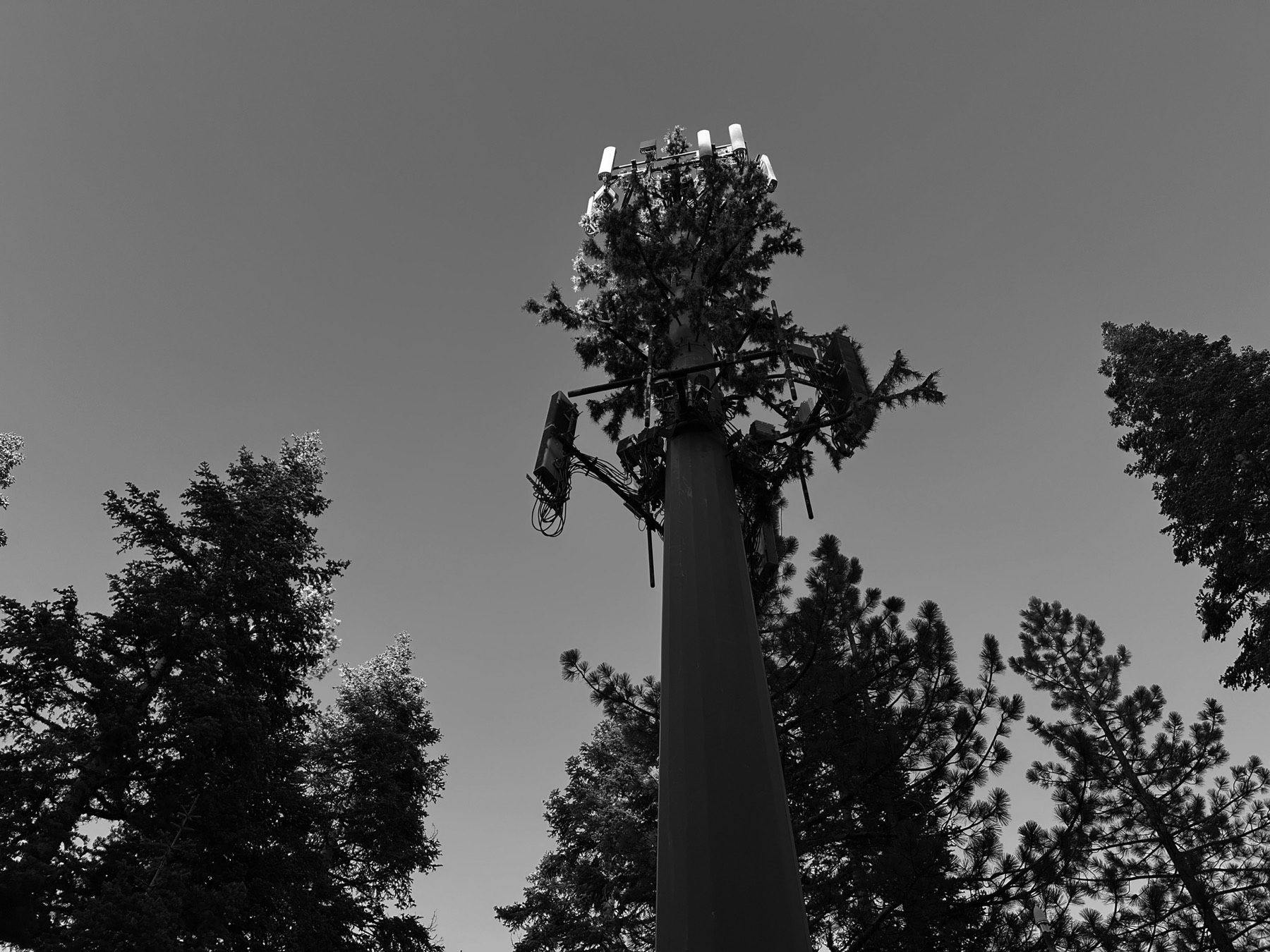
Public hearing · Thursday, June 18, 2026
Placer County is considering approval of Crown Castle & T-Mobile's Alpine Circle Road monopine (PLN22-00178-EOT001 & PLN26-00053), a second 85+-foot cell tower within 500 meters of 200+ residents across 75+ homes, approved without an environmental impact review.
We don't oppose cell towers. We want Placer County to follow the process, not skip review with a categorical exemption.
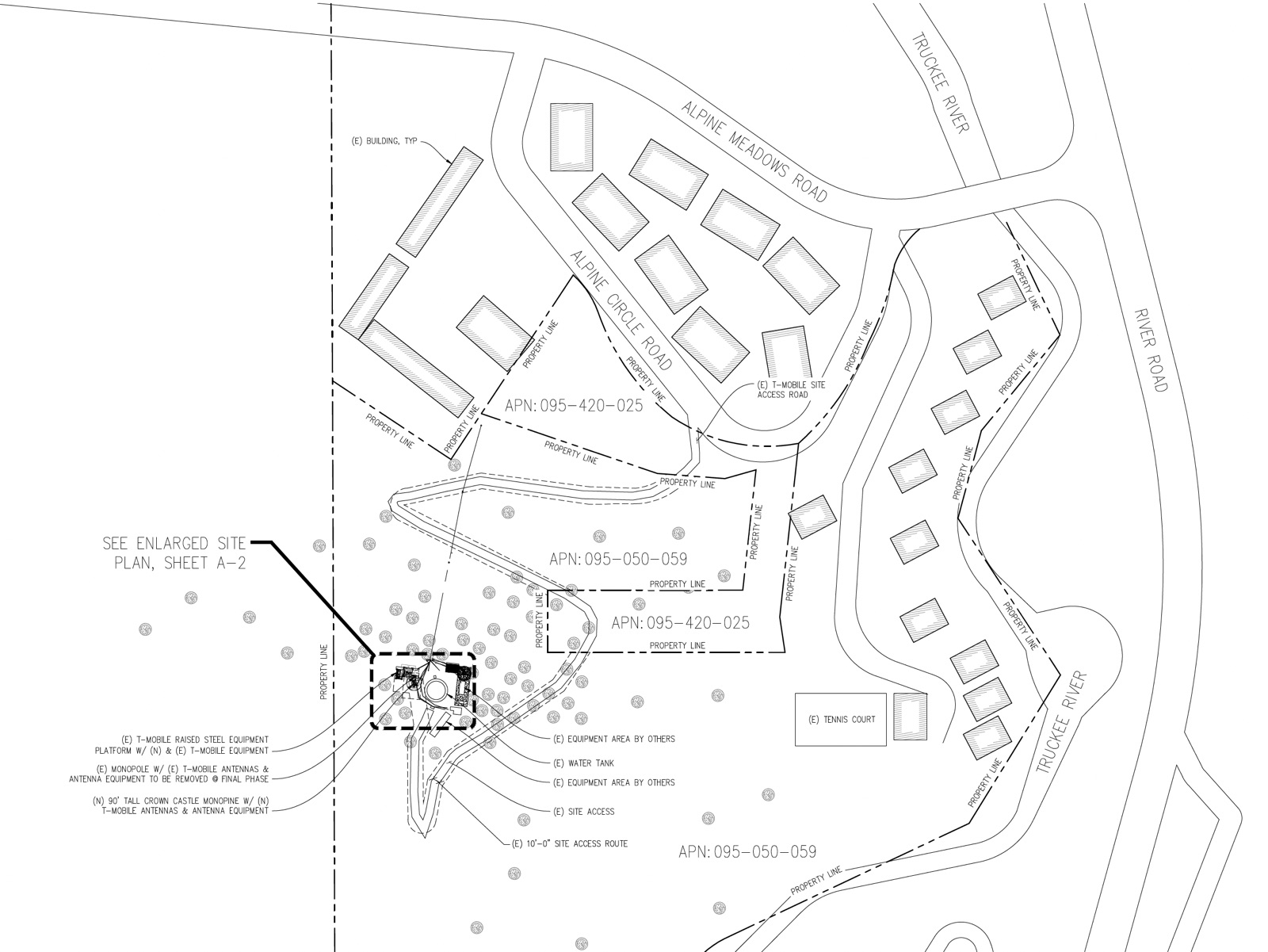
The application before the Placer County Zoning Administrator on June 18 is not a minor modification. It bundles two actions into a single agenda item, a two-year extension of the original permit (applied for in 2022, approved in March 2023) that expired without ever being built, and a relocation of the tower, and asks the County to carry the original findings forward unchanged, all under one categorical exemption. It would add a second carrier tower to a parcel that already has one, within 75–115 meters of the nearest residential property lines.
“The Administrative Review Permit was originally approved on March 21, 2023 … to allow for the replacement of an existing 36-foot-tall monopole cellular facility with a new 85-foot stealth monopine cellular tower (90 feet to top of faux branches) with four new T-Mobile antennas, associated equipment enclosure cabinets, four new remote radio units, and two new hybrid cables at 2235 Alpine Circle Road.”
— Placer County staff report, Proposal (PLN22-00178-EOT001 / PLN26-00053)
A 36-foot pole becomes a 90-foot tower, in the County's own words.
The County is approving a 90-foot tower under a categorical exemption, the category meant for projects with no significant impact, so no environmental study is required.
Replaces a 36-foot monopole with an 85-foot pole, 90 feet to the top of its faux branches.
Measured to the nearest residential property lines. The staff report places the homes themselves at 424–582 ft (≈129–177 m) to the north and east.
An existing monopine, itself ~85 ft (90 ft to its faux branches), already carries AT&T and Verizon on this pad. This project adds a second 90-ft monopine built for up to four carriers, bringing the parcel to as many as six carriers across two 90-foot towers.
A two-year extension of the original approval, a 2022 application approved in March 2023, which expired without being built, plus a relocation modification, under one categorical exemption.
The County reviewed this project under a CEQA categorical exemption. Under CEQA Guidelines §15300.2, an exemption cannot be used when any one of several exceptions is present. At least three apply here.
The site sits near the Truckee River (~750 ft), a §303(d)-listed impaired waterway, and lies within the watershed where the federally threatened Lahontan cutthroat trout and the federally endangered Sierra Nevada yellow-legged frog are documented.
CEQA bars a categorical exemption where successive projects of the same type in the same place are cumulatively significant (Guidelines §15300.2(b)). A multi-carrier monopine, a second tower beside it, and a foreseeable 2027 tank replacement are exactly that, yet the County exempted the project from studying them together.
Before relying on a categorical exemption, the County must confirm no unusual circumstances exist. Here, several plausibly do, an Open Space, water-infrastructure parcel on a steep forested slope, in a high fire-hazard area, within the Truckee River watershed where federally listed species are documented. No such verification appears in the record.
The County's own Conditions of Approval are environmental-protection measures, prohibiting fuel and petroleum discharge to drainage on or adjacent to the site (Condition 3), requiring hazardous-materials notification that the existing 240-gallon fuel tank triggers (Condition 5), and addressing branch debris in the forest (Conditions 9–10). Under Salmon Protection & Watershed Network v. County of Marin, mitigation imposed as conditions of approval cannot support a categorical exemption, it counts only toward a Negative Declaration or EIR. The conditions concede real fuel, spill, and fire risk; that risk belongs in environmental review.
We are also challenging the absence of an alternative-sites analysis required under CEQA Guidelines §15126.6. This is advocacy, not legal advice.
A categorical exemption is a shortcut the law allows only when a project has no real impacts. This one has several — so the process the County skipped is exactly the process that should apply.
Follow these steps and the answer might still be yes — but it would be lawful, studied, and transparent. Our objection isn't the tower. It's the shortcut.

An extension of an expired 2022 permit plus a 9′5″ relocation, bundled into one agenda item — and pushed through under a categorical exemption that skips the notice and review the law requires.

The Truckee River corridor and federally listed species — threatened trout and an endangered frog — sit beside a site the County approved with no environmental review at all.

Generators and stored fuel on a steep, forested wildland-urban-interface slope — and no cumulative fire-risk analysis anywhere in the exemption.

The pad already carries AT&T and Verizon on an existing ~85-ft monopine. This project adds a second 90-ft monopine built to carry even more, with space reserved for additional carriers.

River Run HOA owns the parcel, collects lease income from the carriers on it, and is urging the County to approve — a financial interest the County's record leans on.
The Telecommunications Act preempts opposition based on radio-frequency health concerns. Everything below is what survives that line, and what the County is fully empowered to consider.
A cell-tower farm positioned in a Lake Tahoe view shed
This is Lake Tahoe, where the view belongs to everyone, and the site sits minutes from Palisades Tahoe, one of the region's largest ski resorts. A 90-foot stealth monopine would become a permanent industrial fixture in the views of residents, businesses, and the visitors the area draws.
And the lease is open-ended. Because nothing caps the ridge at two towers, what's sold as a single “replacement” is really the next pole in a growing cell-tower farm on the Tahoe skyline.
A sensitive watershed and threatened species habitat
The site sits near the Truckee River (~750 ft), a 303(d)-listed impaired waterway, and two federally listed species are documented in the watershed:
• Lahontan cutthroat trout, federally threatened
• Sierra Nevada yellow-legged frog, endangered
The County's categorical exemption studies none of it.
An industrial cluster, never studied as a whole
The parcel already hosts an existing monopine carrying AT&T and Verizon. This project adds a second monopine that the County's own staff report says “could support three to four carriers”, its plans reserve space for “antennas by others,” and its conditions require it to accommodate all future carriers. Add the water district's 2027 tank replacement and you have an industrial cluster on one Open Space parcel within 75–115 m of residential property lines, its combined effect never analyzed. Across both towers, this single parcel could hold as many as six carriers.
Generators and fuel tanks in the forest, no wildfire review in the exemption
The towers sit on a graded pad cut into a 40–50% forested slope of mature Jeffrey pine, ponderosa, and Douglas fir, Sierra wildland-urban interface served by a single main road in and out, Alpine Meadows Road to State Route 89. The staff report documents a generator and a 240-gallon fuel tank at the existing T-Mobile facility, and a generator and fuel tank at the neighboring monopine. A second tower adds equipment and stored fuel to an already high-risk site. The serving fire district (North Tahoe Fire Protection District) raised no objection, and its plan review is deferred to the building-permit stage, but the CEQA categorical exemption itself contains no wildfire or wildland-urban-interface analysis, and the cumulative fire risk of the full cluster was never studied.
T-Mobile's own map shows no coverage gap
Crown Castle must show a significant coverage gap and that this tower is the least intrusive way to fill it. It submitted neither.
The coverage map on T-Mobile's own site, now in the County record, shows solid service at this location.
Cell towers measurably lower the value of nearby homes and businesses. This facility's coverage serves Alpine Meadows and the greater area, but the cost of a 90-foot tower falls on the owners within sight of it.
Fewer buyers, many buyers won't consider a home with a visible tower, and a “stealth” monopine doesn't change that.
Longer on the market, fewer interested buyers mean slower sales and weaker negotiating power for the seller.
A lower sale price, reduced demand and longer marketing time translate into a lower final price, steepest for homes in direct view of the tower.
Value loss runs around 8% for a home near a tower, and as much as 20% when it's in direct view of the residence (Bond & Wang, 2005; Affuso et al., 2018).
Bond & Wang (2005), published by the Appraisal Institute, established that proximity to a cell tower measurably reduces property value.
Federal housing guidance classifies cell towers among the “hazards and nuisances” that depress the value of nearby property.
Alpine Meadows is a second-home and resort market where sightlines and natural setting drive price, so a permanent 90-foot structure in a protected viewshed cuts value hardest exactly where buyers pay a premium for the view.
A licensed appraiser's professional opinion, submitted to the County, concludes this tower would reduce the value of nearby homes.
The site sits at the entrance to Alpine Meadows, at the State Route 89 / Alpine Meadows Road intersection, and the County's own photo simulations are shot from exactly there. A 90-foot monopine on that approach is the first thing residents and visitors see.
None of this enters the County's categorical exemption, which weighs no economic impact at all, yet documented value loss is direct evidence that the tower fails the County's own “visually unobtrusive” standard (Zoning Ordinance §17.56.060.F.4) and the Alpine Meadows General Plan's scenic-character objective, the impacts it is required to weigh.
The tower would sit at the entrance to Alpine Meadows, the valley's densest housing, where families, renters, and local workers live. They bear the most impact and have the least voice in proceedings like this. Concentrating the burden here raises the duty to study alternatives and notify neighbors, not lower it.
The parcel is owned by the River Run HOA, which earns lease income from the carrier contracts and is urging approval. A financial interest isn't disqualifying, but the people who profit shouldn't get deference while the views, safety, and property values of surrounding neighborhoods take the hit.
The County's “visually unobtrusive” finding rests on photo simulations from State Route 89 and Alpine Meadows Road, not from the homes that face the tower daily. Its distances are measured to the far edge of each development, never to the nearest homes:
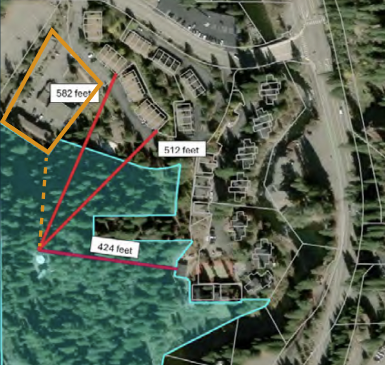
The apartments sit at the valley entrance, in direct line of sight of the proposed tower.
“As shown in Figure 1 below, the Alpine Village Apartments, the Alpine Manor One and Alpine Manor Two residential developments are located approximately 512 to 582 feet to the north, and the River Run residential development is approximately 424 feet to the east of T-Mobile's lease area. To the west of the subject site is a large 58-acre United States Forest Service-owned parcel with miscellaneous recreational uses. The Truckee River is located approximately 750 feet to the east of the subject site.”
Placer County staff report (PLN26-00053), Existing Conditions, Figure 1
By property line, the Alpine Village Apartments are likely the closest and densest homes to the site, yet their true proximity is never shown. The modification even shifts the tower 9′5″ north, toward those homes. A tower can read as “stealth” from the highway and still dominate the view next door.
This isn't a new project. T-Mobile's 36-foot pole has carried service here for more than twenty years, so June 18 isn't about whether Alpine Meadows and the surrounding area get coverage. It's about turning that pole into a 90-foot tower built for multiple carriers beyond T-Mobile, with space reserved for “antennas by others.” The replacement was approved in 2023, drew no public comment, and was never built. Now the County is asked to extend it, shift it nine feet north, and carry the original findings forward, still under a categorical exemption, with no environmental review.
The approved tower couldn't be built where it was approved
Staff admits the 2023-approved location had a construction conflict with the hillslope behind it, which is why the applicant now needs to shift the tower nine feet north and redesign it. Yet the same staff report finds “no change of conditions or circumstances” under §17.58.160(C)(1), the very test for granting the extension. A project that has to move and be redesigned because the approved location proved unbuildable is, by definition, a changed circumstance.
The original approval (PLN22-00178, a 2022 application approved in March 2023) used a notification radius measured 300 feet from the proposed cell tower location, not from the property boundary as the law requires.
The tower sits 142.47 meters (467 feet) inside the 10.8-acre parcel. A 300-foot circle drawn from the tower stops well short of the parcel boundary in every direction. As a result, many residents who would have been within the lawfully-required radius never received notice of the project's original approval.
The 2026 staff report has expanded the notification radius for this hearing, a constructive correction going forward, but the substantive record being extended was built without the broader community's input.
“Due legal notification of these applications was given to property owners within 300 feet of the property lines of the subject property.”Placer County Zoning Administrator agenda, June 18, 2026 The standard the original 2023 notice did not meet.
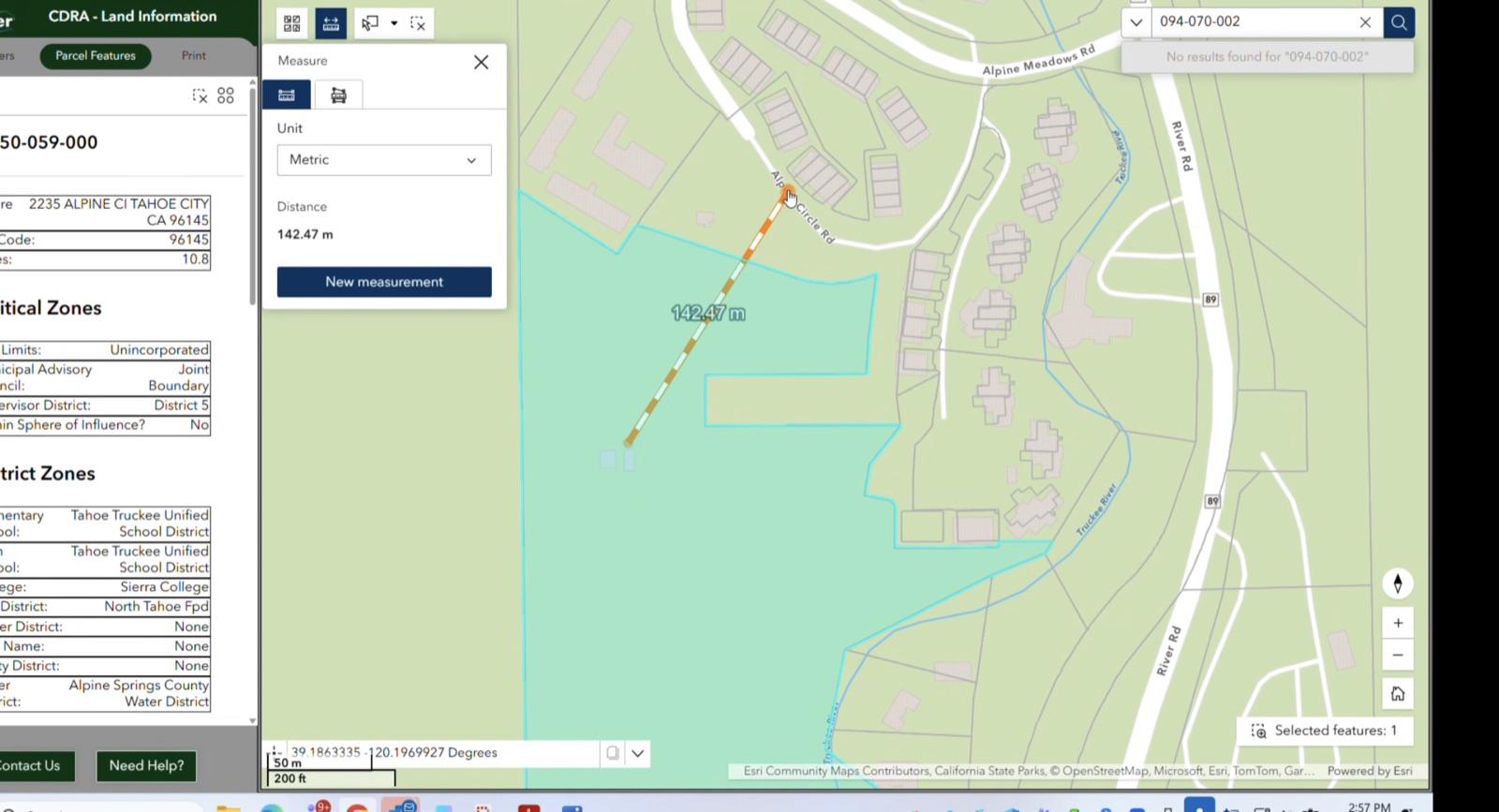
The notice that never reached the neighbors
142.47 meters (467 feet) from the proposed tower to the nearest parcel boundary, but the 300-foot notice radius reaches only 91.44 meters. The circle drawn from the tower never touches the property line.
These owners' financial stake is a matter of public record. Three documents, all obtained through California Public Records Act requests, establish it:
The April 3, 2026 letter from the River Run HOA President, advocating prompt approval. The River Run HOA owns the parcel hosting the proposed tower and receives lease income from the carrier contracts on the site.
The April 17 and April 20, 2026 emails from a River Run HOA Board member who manages the carrier contracts at the site, also advocating prompt approval.
The 2021 Letter of Authorization for the carrier's use of the parcel, signed in July 2021 by that same Board member, one year before the original 2022 application and four years before the 2026 re-application now being urged on the County.
The financial interest is not, in itself, disqualifying. But the County's record leans heavily on comments from owners with this documented stake, the same River Run board member who signed the 2021 Letter of Authorization is now urging approval. Meanwhile, the residents who bear the impact but gain nothing were excluded from the original review by the flawed notice radius.
Profit over community, a financial incentive for River Run
River Run HOA owns the parcel, collects a significant amount of lease income, and backs the approval.
These California decisions address when a CEQA categorical exemption can — and cannot — be applied to a wireless tower. They are ordered by how directly they bear on PLN26-00053.
TIER 1 — DIRECTLY APPLICABLE PRECEDENT
Snowcreek VII HOA v. Town of Mammoth Lakes
The court overturned approval of an 80-ft AT&T monopine, holding an 80-foot tower is not analogous to the “small structures” — stores, motels, offices — that the §15303 exemption covers. It ordered the permit cancelled and full CEQA review.
Relevance: PLN26-00053's tower is taller still — 85 ft (90 ft to the branch tips). Same exemption class, comparable project, a published 2025 result against it.
Salmon Protection & Watershed Network v. County of Marin
Held that mitigation measures imposed as conditions of approval cannot prop up a categorical exemption — they may count only toward a Negative Declaration or EIR.
Relevance: The approval leans on conditions of approval, including a requirement to accommodate all future carriers. Under SPAWN, those conditions can't substitute for the review the project skipped.
Berkeley Hillside Preservation v. City of Berkeley
Set the controlling two-part test for the “unusual circumstances” exception (§15300.2(c)): show unusual circumstances, then whether they create a reasonable possibility of significant impact — if so, CEQA review is required.
Relevance: Unusual circumstances here include an Open Space / water-infrastructure parcel, documented listed species in the watershed, and a high fire-hazard setting with on-site generators and fuel tanks.
TIER 2 — SUPPORTING PRECEDENT
Children's Health Defense v. County of Los Angeles
Held that CEQA is not preempted by federal telecommunications law and applies to wireless permitting. County ordinances exempting wireless projects still involve discretionary decisions that require CEQA compliance unless a specific exemption applies.
Relevance: The County can't wave this through as “federally preempted.” CEQA applies — the only question is whether a valid exemption does.
Parkford Owners for a Better Community v. County of Placer
The Third Appellate District found Placer County violated CEQA in its review of a Tahoe/Sierra-region project and required proper CEQA compliance before the County could proceed.
Relevance: This is the court that would hear any appeal of PLN26-00053 — and it has already held Placer County to CEQA in this region.
T-Mobile West LLC v. City and County of San Francisco
A unanimous California Supreme Court upheld a city ordinance regulating wireless facilities on aesthetic grounds, holding state law (Pub. Util. Code §7901) does not preempt local governments from conditioning or denying towers to protect community aesthetics.
Relevance: Aesthetics aren't a “soft” objection — they are a legally valid basis for the County to regulate or deny this tower. A cell-tower farm in the Lake Tahoe viewshed is squarely within the County's authority.
TIER 3 — LOCAL & CONTEXTUAL
Dog Bar Road · Verizon (Grass Valley)
After a year of public meetings, the Nevada County (CA) Board of Supervisors denied a Verizon tower set about 100 feet from four homes and asked the carrier to relocate it to “a safe and responsible site away from homes and families.” Verizon then sued the County in federal court; a resident intervened to defend the decision, and the matter is ongoing.
Relevance: A California county recently used its land-use authority to deny a tower too close to homes — proof a county can say no. It also shows why this fight stays on land-use and CEQA grounds, and why objecting on the record now matters.
Armstrong v. County of Placer
Owners challenged Placer County's approval of a 110-ft AT&T 5G tower at Martis Camp. A restraining order was denied on laches — they filed three days before construction — so the court never reached the merits.
Relevance: The cautionary lesson: objections must be on the record at the earliest stage. That is exactly why comments before June 18 matter.
Incline Village monopine (Lake Tahoe)
Commissioners voted 5–0 to deny a 117-foot monopine built to host up to four carriers, sited about 100 feet from the town center — finding it detrimental to neighborhood character and not genuinely “stealthy,” with public comment running 100-to-1 against.
Relevance: A Lake Tahoe jurisdiction unanimously rejected a taller, multi-carrier monopine on character and aesthetic grounds alone — the closest comparable to this project, in the same basin.
WHAT THE COUNTY'S OWN CODE REQUIRES
It qualifies only if it “looks like a tree”
The 2023 approval relied on the exemption for “antennas that appear to be natural features indigenous to the site” — the stealth-monopine path. An 85-foot pole straining to read as a tree is exactly what Snowcreek rejected. A freestanding tower that doesn't genuinely meet that standard requires a discretionary minor use permit (Note 3) — and CEQA review.
The ordinance's own goal is fewer, lower towers
The code's stated purpose is to “minimize the adverse impacts of such equipment and structures on neighborhoods… by limiting the height, number, and location” of towers. A second, taller tower beside an existing one runs against the County's own standard — which also names “adverse noise from generators.”
An extension needs findings the record can't support
The hearing body may extend a permit only if it finds no change of circumstances that would have been grounds for denial, that the applicant was diligent, and that modified conditions update it to current standards. The permit expired unbuilt, and circumstances changed — relocation, multi-carrier expansion, and intervening case law.
Every claim on this page comes from the public record. These are the primary documents.
The County's recommendation, findings, and CEQA determination (PLN26-00053).
Open → Staff report — April 16, 2026The original staff report prepared for the first hearing (PLN26-00053).
Open → Parcel Review Committee Agenda — May 21, 2026The continued-hearing version of the County's recommendation (PLN26-00053).
Open → Notice of Public Hearing — June 18, 2026The County's published notice for the June 18 hearing — issued under the expanded radius that corrected the flawed radius used for the original approval.
Open → Staff report — June 18, 2026Zoning Administrator agenda; our matter is Item 6, heard at 10:25 AM.
Open → Alpine Manors HOA formal protestThe procedural and CEQA objections filed for the record by the Alpine Manor I HOA.
Open →The Zoning Administrator hears our matter, Item 6, at 10:25 AM, after the 10:00 AM open. Attend in person, join online, call in, or comment in writing.
Planning Commission Hearing Room 3091 County Center Drive, Auburn, CA 95603 Doors open 10:00 AM · Item 6 heard at 10:25 AM
placer-ca-gov.zoom.us/j/91023942163 Webinar ID 910 2394 2163, use “raise hand” to comment live
Call 877-853-5247 or 888-788-0099 Webinar ID 910 2394 2163
Watch: youtube.com/@placercomeetings Write: zoningadministrator@placer.ca.gov 175 Fulweiler Avenue, Auburn, CA 95603
You don't have to own property to be heard. Renters, homeowners, business owners, and visitors all have a voice, and every comment becomes part of the public record the Zoning Administrator must consider. If you live or work in Alpine Meadows, your voice counts.
Thursday, June 18, 2026 · 10:00 AM
Planning Commission Hearing Room · Auburn, California
Our matter, Item 6, is heard at 10:25 AM
Item (PLN22-00178-EOT001 & PLN26-00053) · Crown Castle · T-Mobile · River Run

More people to reach
Your comment to the Zoning Administrator carries the most weight, but your planner and your supervisor matter too.
Placer County CDRA
zoningadministrator@placer.ca.gov
175 Fulweiler Ave, Auburn, CA 95603 · (530) 889-4020
Zoning Administrator, Placer County
Decides PLN26-00053, address comments to the Zoning Administrator Clerk
Senior Planner, Placer County CDRA
hbeckman@placer.ca.gov
(530) 338-6484
Staff Services Analyst, Placer County CDRA
cbetker@placer.ca.gov
Placer County Board of Supervisors
cgustafson@placer.ca.gov
(530) 889-4020
North Tahoe Fire Protection District
(530) 583-6911
www.ntfire.net
Alpine Meadows Voice is an independent, volunteer effort by homeowners and residents of Alpine Meadows. We're not a company, an industry group, or anyone's competitor, and no one is funding us. We support reliable cell service. What we're asking for is a real environmental review and a fair public process before a 90-foot tower goes up at the entrance to our community.
No company, industry group, or competitor, and no outside funding. Just neighbors.
We're neighbors and community members of Alpine Meadows, raising awareness about this project and what it means for the place we call home.
Every claim on this site is drawn from Placer County's own public documents, verify any of it.